
AI Masters Degree Program in Alaska
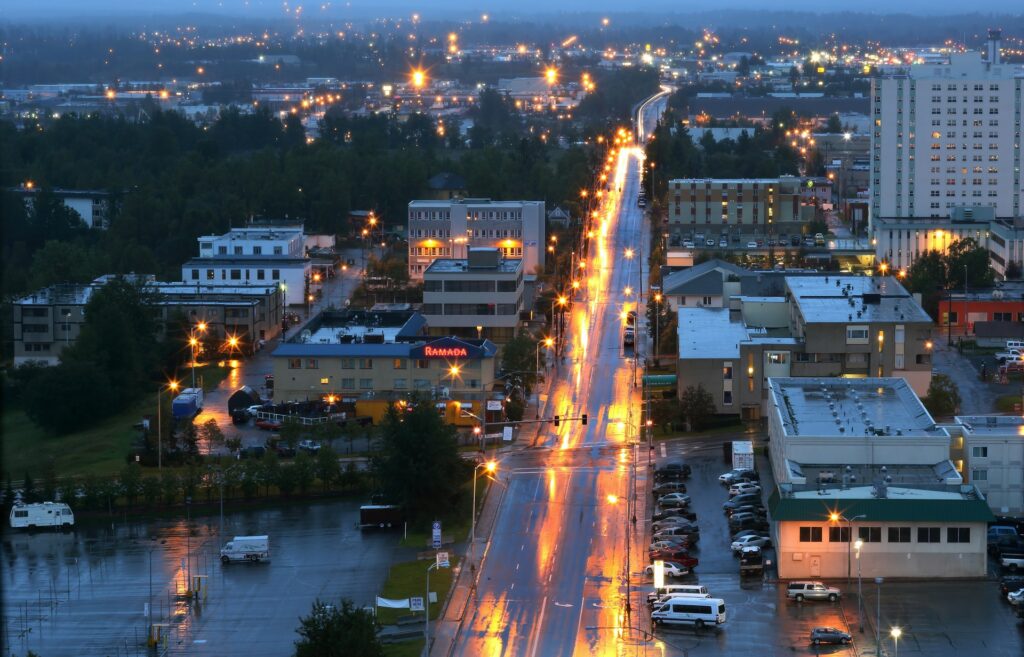
The only AI masters degree program currently available for on-campus attendance in Alaska is University of Alaska Anchorage’s program, launched in Fall 2025. This program offers you a chance to build AI models from scratch rather than simply using existing tools. This Master of Science in Artificial Intelligence, Data Science, and Engineering brings together three departments: Computer Science & Engineering, Electrical Engineering, and Geomatics. The program prepares you to solve complex ground problems using advanced machine learning and data science tools. You might be interested in addressing Alaska’s energy infrastructure challenges or advancing climate change solutions. This guide covers everything in UAA’s newest graduate program.
Program Overview: What Makes UAA’s AI Masters Degree Unique
Interdisciplinary Collaboration Between Three Engineering Departments
Three departments within the College of Engineering work together to deliver this program: Computer Science & Engineering, Electrical Engineering, and Geomatics. The Department of Electrical Engineering houses the program, but all three departments provide equal support in curriculum development and instruction. This structure emerged from repeated student requests for an interdisciplinary graduate degree focused on data science applications.
The collaboration reflects a fundamental move in how engineering disciplines operate. Faculty members Mohammad Heidari Kapourchali, Masoumeh Heidari Kapourchali, and Caixia Wang developed the program with input from departmental advisory boards. Mohammad explains the rationale: “The three departments put together this program [because] we feel like the engineering disciplines are overlapping now. So if you’re doing research in AI […] the opportunities are really at these intersections. That’s how we saw it”.
The 30-credit program runs in a hybrid format and combines asynchronous online courses, synchronous online sessions, and in-person instruction where hands-on skills require physical presence. This format accommodates both full-time students and working professionals who seek to advance their expertise.
The UAA masters degrees include this program because it addresses workforce demands in industries vital to Alaska’s economy and development. The program maintains flexibility for non-engineering students who want expertise in applied data science and offers courses that give you the knowing how to extract insights from large datasets.
Focus on Building AI Models, Not Just Using Them
Your coursework goes beyond using pre-built AI tools. Masoumeh Heidari Kapourchali clarifies this difference: “What we cover in this program is teaching them how to develop models, not just using it”. You’ll acquire programming and technical skills to construct custom models tailored to specific applications.
This approach is different from programs that train you to work with existing AI platforms. You learn the underlying architecture and mathematics that power AI systems instead. You’ll understand how to design algorithms from the ground up, select appropriate neural network structures, and optimize model performance for particular use cases.
The emphasis on model creation means you graduate with capabilities that extend beyond current tools. You’ll possess the foundational knowledge to adapt and create solutions using emerging techniques as AI technology advances. You’ll learn to build your own models for your own applications and gain independence from vendor-specific platforms.
This hands-on creation process involves working with real datasets and implementing algorithms. You test model performance against ground constraints. You’ll troubleshoot issues that arise during model development, refine parameters, and verify results. These experiences prepare you to lead AI initiatives rather than simply participate in them.
Designed for Data-Centric Era Challenges
The UAA master’s programs include this degree to give you skills for tackling ground challenges in data analysis, interpretation, and utilization. The program originated when students approached the college about a curriculum that applies AI and data science to persistent Alaska challenges with natural resources, disaster recovery, and electricity production.
You’ll develop capabilities to address pressing challenges in Alaska while building skills applicable to national interests such as disaster resilience and energy systems. The program trains you to handle expanding data needs in industries critical to Alaska’s economy: oil and gas, natural resources management, fisheries, transportation, and healthcare.
Wang, who chairs the Department of Geomatics, explains emerging data sources: “It is going to be very helpful for Alaska, since we have lots of images captured by satellite and now by drone. How are you going to use that data—that’s math, that’s vast data—to answer those questions?”. These new forms of spatial data require sophisticated AI models to extract meaningful insights.
Mohammad points to ground applications like the 2019 Swan Lake Fire, which caused power outages across Alaska. The program’s techniques could help “calculate the risk of wildfires” and “improve the resilience of the state when it comes to natural hazards”. AI models capable of analyzing massive datasets are required to understand these hazards.
The program encourages collaboration between students, faculty, and industry partners and creates a research community at the university. Graduates join Alaska’s workforce and contribute to growth and efficiency in local industries directly. They support the state’s economic development.
Admission Requirements for the MS AIDE Program
Required Educational Background and Documents
Applying to the AI masters degree program requires a baccalaureate degree in engineering or a closely related discipline. You must submit your application through the UAA Office of Admissions along with documentation that demonstrates your readiness for graduate-level work.
Your application package needs two letters of recommendation from professors or other professionals who can attest to your qualifications for graduate study. These recommenders should know your academic capabilities and technical skills well enough to provide meaningful insights about your potential success in the program.
You’ll submit a resume or curriculum vitae that details your educational background, work experience, technical skills and relevant projects. This document helps the admissions committee understand your hands-on experience and how it relates to artificial intelligence and data science applications.
A one-page personal statement forms a critical component of your application. This statement provides your chance to discuss credentials and readiness for graduate studies that wouldn’t appear on the application form or official transcripts. Use this space to share relevant qualifications, experience and your interest in pursuing graduate study in artificial intelligence, data science and engineering. Your statement should state your desire and commitment to the program in your own voice.
Official transcripts showing completion and conferral of your baccalaureate degree must come directly from the issuing institution to the UAA Office of Admissions. Students who completed degrees outside the United States or English Canada will need to have their transcripts translated and evaluated using World Education Services Basic Course-by-Course Evaluation. Students who expect to receive their baccalaureate degree within two semesters may apply for graduate admission.
The program requires either a cumulative grade point average of 3.00 on a 4.00 scale or you must meet the GPA requirements of the MS AIDE program. Your credentials should indicate knowing how to pursue graduate work successfully.
GPA and Credit Requirements for Accelerated Option
Current UAA baccalaureate students enrolled in engineering or a closely related discipline can apply for admission at the conclusion of their junior year. This accelerated pathway benefits students already in the BS Geomatics, BSCS, BSCSE, or BSEE programs who want to begin graduate work while completing their undergraduate requirements.
Students admitted through the Accelerated MS AIDE Option may apply up to nine credits of 400-level coursework from their undergraduate programs toward the MS AIDE graduation requirements. This credit transfer option reduces the total time and courses needed to complete both degrees.
The accelerated option carries eligibility criteria beyond standard admission requirements. You must have completed at least 60% of the credits toward your BS Geomatics, BSCS, BSCSE, or BSEE program requirements. Your performance matters: you need a minimum grade point average of 3.00 for all coursework completed at UAA. You must also have completed at least 24 credit hours at UAA.
Students admitted to the accelerated option must still complete their baccalaureate degree requirements before receiving the MS AIDE. No more than nine credits may be completed in your graduate program before program admission. This ensures you maintain focus on completing your undergraduate degree while beginning graduate coursework strategically.
Personal Statement and Recommendation Guidelines
Your personal statement serves as more than a formality. Admissions committees get into these statements carefully to assess motivation, clarity of goals and program fit beyond what numeric scores reveal. The statement showcases communication skills and genuine interest in AI that transcripts cannot capture.
Write your statement authentically in your own voice. The final content should reflect your individual experiences and point of view, though you may seek feedback or editing suggestions. Think about the program’s focus on building AI models and solving Alaska-focused challenges when you state your interests and goals.
Your two recommendation letters should come from individuals who can speak to your qualifications for graduate study. Professors who taught you in upper-level courses, research supervisors or professional mentors in technical fields make strong recommenders. Generic letters carry less weight than examples of your analytical abilities, technical competencies and problem-solving skills.
Choose recommenders who know your work well enough to provide concrete examples. Someone who supervised your senior project, worked with you on research or managed you in a technical role can offer insights that strengthen your application. Give recommenders sufficient time and context about the program so they can tailor their letters appropriately.
Three Flexible Completion Pathways to Choose From
You complete the AI master’s degree program at University of Alaska Anchorage through one of three distinct pathways. Each requires 30 credits but differs in how you show mastery of the material. Your choice depends on career goals, research interests, and preferred learning style.
1. Thesis Option Requirements and Timeline
The thesis pathway centers on original research that contributes to your field’s body of knowledge. You complete 30 credits of coursework. Six credits are dedicated to thesis work through CSCE A699, EE A699, or GEO A699.
Your thesis must meet specific scholarly standards. The work requires a literature review showing how your research connects to current developments in your field. Your graduate committee reviews whether the thesis quality reaches publishable standards for peer-reviewed journals. Besides showing command of knowledge and skills in your area, you prove capability to advance the discipline through original contributions.
The timeline spans multiple semesters. You submit a thesis proposal to your graduate committee at least one semester before your defense. The proposal presents an explicit problem statement, literature review, and sections describing your research and analytical methods. It must provide evidence that you will satisfy all thesis requirements.
You defend your completed thesis through an oral presentation to your graduate committee in a session open to the public. The defense tests your knowing how to explain methodology, justify decisions, and respond to critical questions about your work.
2. Project Option for Applied Learning
The project pathway suits students seeking applied experience without the extensive research timeline a thesis requires. You complete 30 credits. Six credits go toward a data science and engineering project through CSCE A698A, EE A698A, or GEO A698.
Your project unfolds as an individual study with three major deliverables submitted to your advisory committee. First, you develop a project proposal for committee approval. The proposal outlines your intended work and approach.
Next, you submit a draft project report for committee review. The report has an introduction, literature review, methodology section where applicable, results, conclusions, recommendations, and references. Your committee provides feedback on this draft.
You then produce a final project report that incorporates improvements and suggestions from your advisory committee. Professional environments mirror this iterative process where technical work undergoes multiple review cycles before completion.
The project option prepares you for roles emphasizing practical application of AI and data science techniques. You build tangible deliverables that show your knowing how to execute complex technical work from conception through completion.
3. Detailed Exam Alternative Path
The detailed exam pathway offers flexibility for students who prefer showing knowledge through testing rather than extended research or project work. You complete 30 credits of coursework and take a detailed exam during your final semester.
The exam preparation process begins when you and your advisor review your completed coursework from the Graduate Studies Plan. Your advisor uses aspects of this review to create an exam based on four courses you completed during the program. Your advisor makes the final decision on which courses form the exam basis.
You and your advisor establish the time period over which you take the exam. Additional requirements get stated before the exam date. The structure allows customization based on your specific coursework and strengths.
The detailed exam tests your knowing how to combine material from multiple courses and apply concepts to solve problems and think at a professional level. The pathway works well if you excel at integrating knowledge from different areas and showing understanding through examination formats.
All three pathways lead to the same University of Alaska Anchorage master’s degree credential, but each develops different skills and produces different evidence of your capabilities for future employers or doctoral programs.
Alaska-Focused Applications and Real-World Problem Solving
Addressing Energy Infrastructure and Natural Hazards
Alaska’s geographic isolation and extreme environmental conditions create infrastructure vulnerabilities that require specialized AI solutions. The master’s programs through the College of Engineering hosts the Alaska AI Solutions Consortium and addresses these challenges by bringing together academic researchers, industry partners, and community stakeholders. The consortium supports interdisciplinary AI projects focused on energy infrastructure, healthcare, transportation, and environmental sustainability for Alaska’s needs.
Climate-driven hazards pose mounting threats to energy infrastructure. The Foundations for Improving Resilience in the Energy Sector Against Wildfires on Alaskan Lands (FIREWALL) project employs AI to improve power grid resilience against wildfire damage. Permafrost degradation poses another critical challenge. A 2019 Statewide Threat Assessment identified 31 rural Alaska communities facing most important infrastructure damage from erosion, flooding, and permafrost thaw. River bank erosion at 70 feet per year threatens homes, schools, and the airport in Newtok due to permafrost degradation.
Predictive maintenance provides operators with enhanced warnings of potential equipment degradation or failure through AI applications in energy infrastructure. Equipment most needing maintenance can be prioritized, and costly failures can be prevented before they occur while reliability improves. Anomalous event detection helps identify non-malicious issues like arcs, pipe freezes, and faults in real-time. Operators can prevent problems from escalating across the system.
Geospatial AI for Satellite and Drone Data
Satellite and drone imagery generates vast datasets that require sophisticated AI processing to extract useful insights. Geomatics faculty highlight this challenge: “we have lots of images captured by satellite and now by drone. How are you going to use that data” to answer critical questions. Machine learning algorithms forecast equipment failures and environmental risks by analyzing detailed imagery patterns through AI-driven predictive analytics.
Real-time infrastructure inspections for pipelines, powerlines, and construction sites become possible with drone data and improve asset management efficiency. UAVs detect structural weaknesses and failures that might otherwise go unnoticed in the energy sector. Automated image classification identifies patterns such as crop stress or equipment faults without manual analysis and processes large datasets quickly to provide useful insights.
Changes in land use, water levels, and infrastructure conditions can be analyzed through high-resolution satellite imagery processing. Thermal and multispectral imaging detect issues invisible to standard photography. Global climate models calculate risk only for areas spanning 62 to 124 miles. Specialized AI tools can make projections for regions just 2.5 miles across.
Community Collaboration Opportunities
Industry professionals, government entities, community organizations, and UAA students and faculty can participate in the consortium. The structure encourages involvement from people with varied academic backgrounds to promote interdisciplinary solutions. Projects target health improvements for Alaska Native communities, wildfire risk mitigation, and permafrost monitoring.
Partnerships between students, faculty, and industry partners extend collaboration beyond campus boundaries and are the foundations of a research community. Graduates can contribute to Alaska’s economic development by joining the state’s workforce with skills that address local industry needs through these connections.
Career Skills and Professional Outcomes After Graduation
Advanced Data Engineering and Analytical Capabilities
You develop exceptional data management and processing skills to handle large volumes of data with efficiency. These capabilities include cleaning, organizing and preparing datasets before training AI models through techniques like data wrangling and preprocessing. You gain proficiency in designing experiments to test model performance and interpret results. You identify sources of error and optimize hyperparameters to improve accuracy.
Mathematics forms the backbone of AI and machine learning, and your technical foundation builds on it. Statistics and probability enable you to assess models, analyze predictions and make decisions while you calculate uncertainty. Linear algebra provides the foundation for handling multi-dimensional datasets and operations like matrix multiplication. Techniques such as singular value decomposition are commonly used in dimensionality reduction. You also learn to design data lake and data storage architectures for different use cases. You explore how storage choices affect query performance and cost.
Graduate-Level Theory Application
You acquire the skill to design algorithms that learn from data and make predictions. You become competent in supervised, unsupervised and reinforcement learning. The program emphasizes breaking complex problems into smaller technical questions. This helps you identify what can be automated and what should remain human-controlled. You learn what risks must be managed before deployment.
Professional Communication and Teamwork Skills
AI professionals need more than technical proficiency. You develop strong communication skills to explain technical concepts to people without AI backgrounds. Stakeholders and clients need to understand how AI affects their work without getting lost in jargon. Collaboration becomes essential as AI projects require working with data scientists and software engineers. Teamwork allows each member to contribute their expertise and prepares you to lead cooperative teams.
Make your Start Today
The AI master’s degree program at University of Alaska Anchorage stands apart through its interdisciplinary structure and hands-on approach to model development. You won’t just learn to use existing AI tools. You’ll build custom models from scratch that address Alaska’s unique challenges in energy infrastructure, natural hazards and geospatial analysis. This focus on creation rather than consumption prepares you to lead in industries of all types experiencing rapid data expansion. The three flexible completion pathways accommodate both full-time students and working professionals. You can choose the learning approach that fits your career goals. This program positions you to contribute to Alaska’s economic development while building skills applicable nationwide.