
Free STEM Resources for Girls and Women in AI, Machine Learning, and Data Science
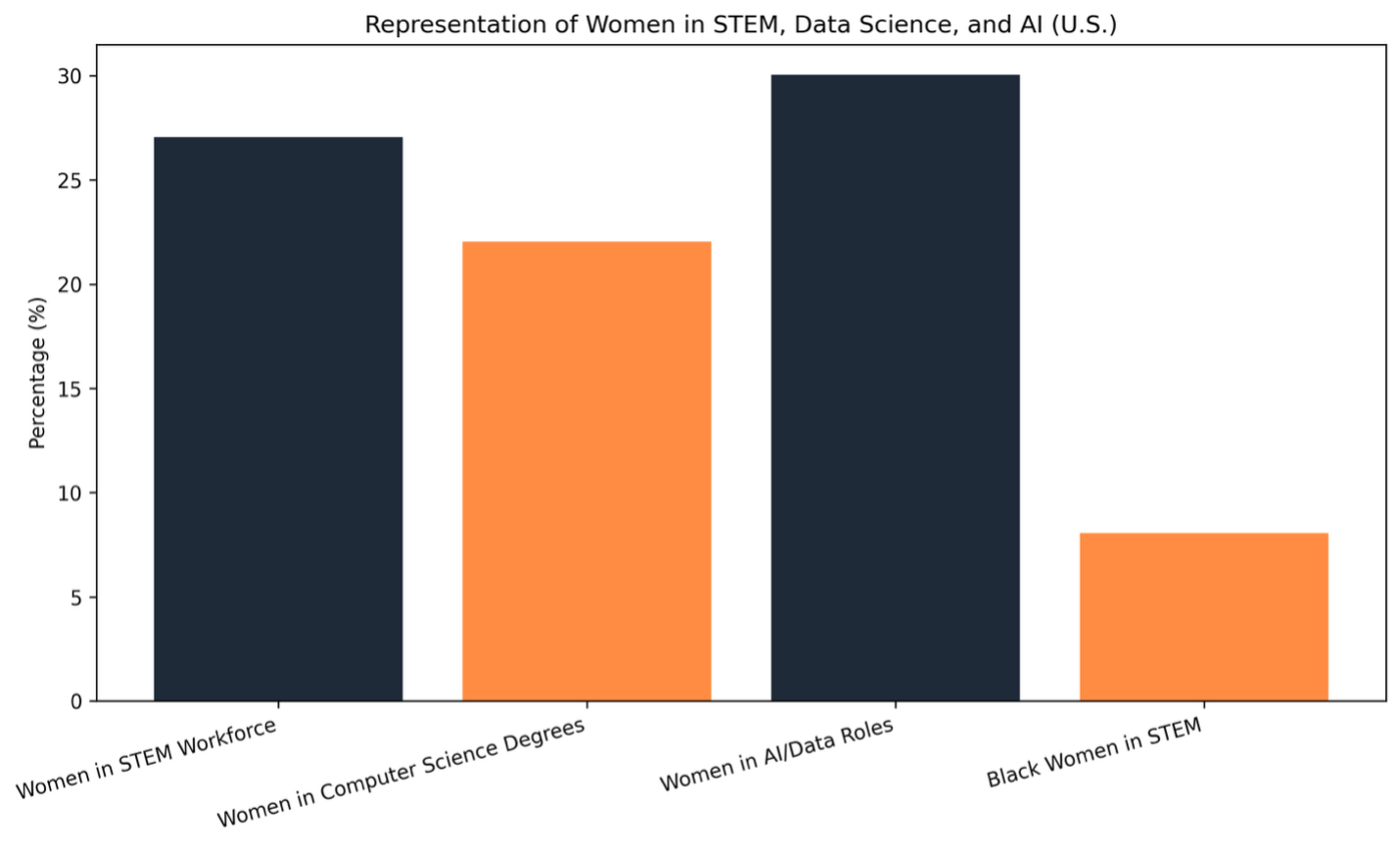
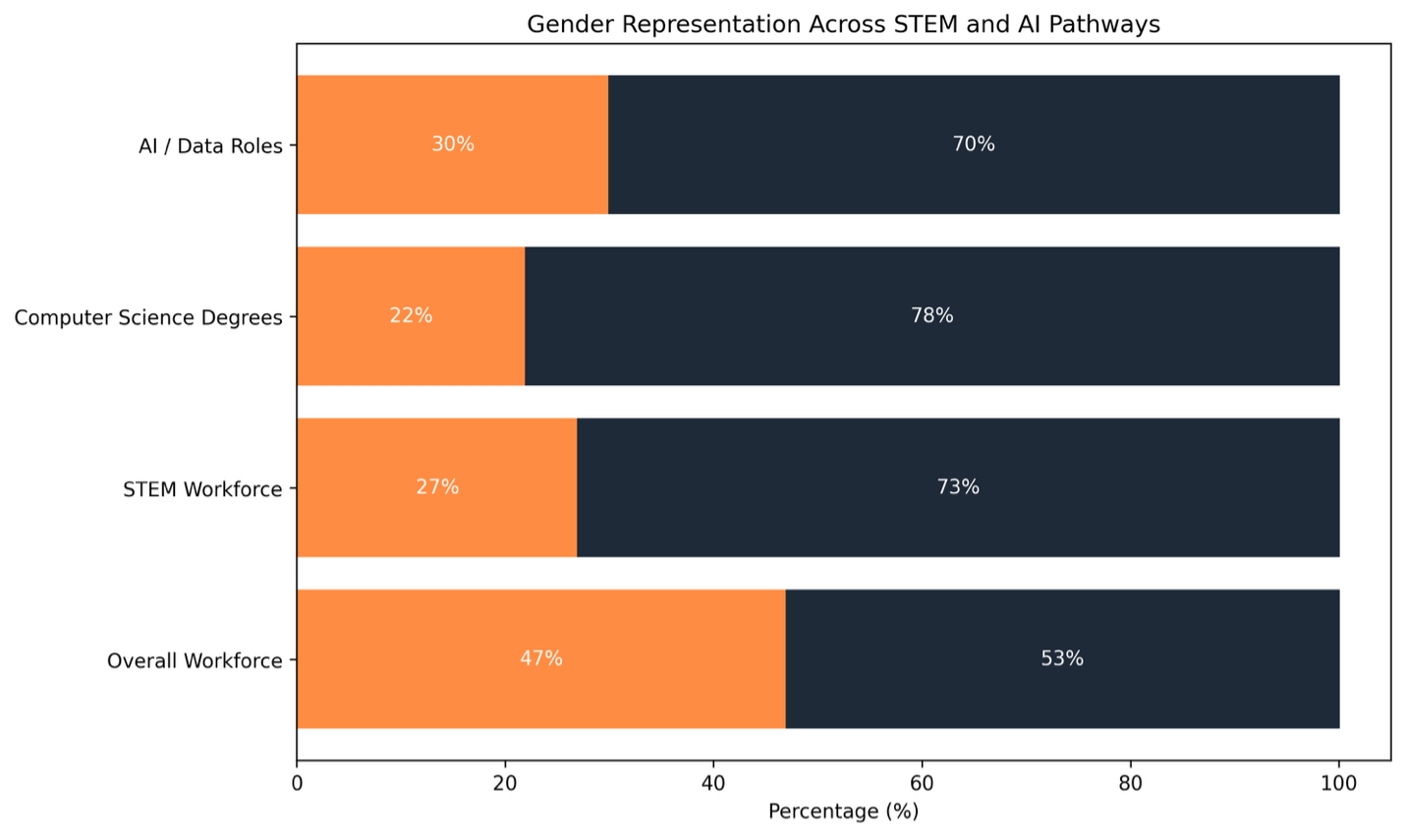
According to the U.S. Census Bureau, women make up roughly half of the U.S. population and workforce, yet they remain significantly underrepresented in science, technology, engineering, and math (STEM) careers. Women hold only about 27% of STEM jobs, despite earning more than half of all college degrees overall.
The disparity is even more pronounced in specialized and rapidly growing fields such as data science, machine learning, and artificial intelligence (AI). Black and African American women account for less than 8% of the STEM workforce, highlighting the compounded impact of gender and racial inequities.
Historically, women played a much larger role in computing. Up until the mid-1980s, women made up nearly 50% of computer programmers in the United States. Since then, participation has declined sharply. Today, women make up less than 30% of professionals working directly in artificial intelligence, with similar underrepresentation in data science and machine learning roles.
Understanding why this gap exists—and how to close it—is critical. Research shows that girls often express strong interest in STEM at a young age, but that interest declines during adolescence due to factors such as unconscious bias, lack of representation, confidence gaps in math, and limited exposure to real-world applications of technical skills.
The good news is that access to free, high-quality learning resources can play a powerful role in reversing these trends. From early childhood through professional development, exposure to inclusive STEM education, mentorship, and role models can help girls and women build confidence and pursue careers in data science, machine learning, and AI.
Why Women Aren’t Pursuing STEM Careers in Data Science, Machine Learning, and AI
To meaningfully increase women’s participation in data science, machine learning, and artificial intelligence (AI), it is critical to understand why so many girls and women opt out of these pathways long before entering the workforce.
Research shows that interest is not the problem. Retention is.
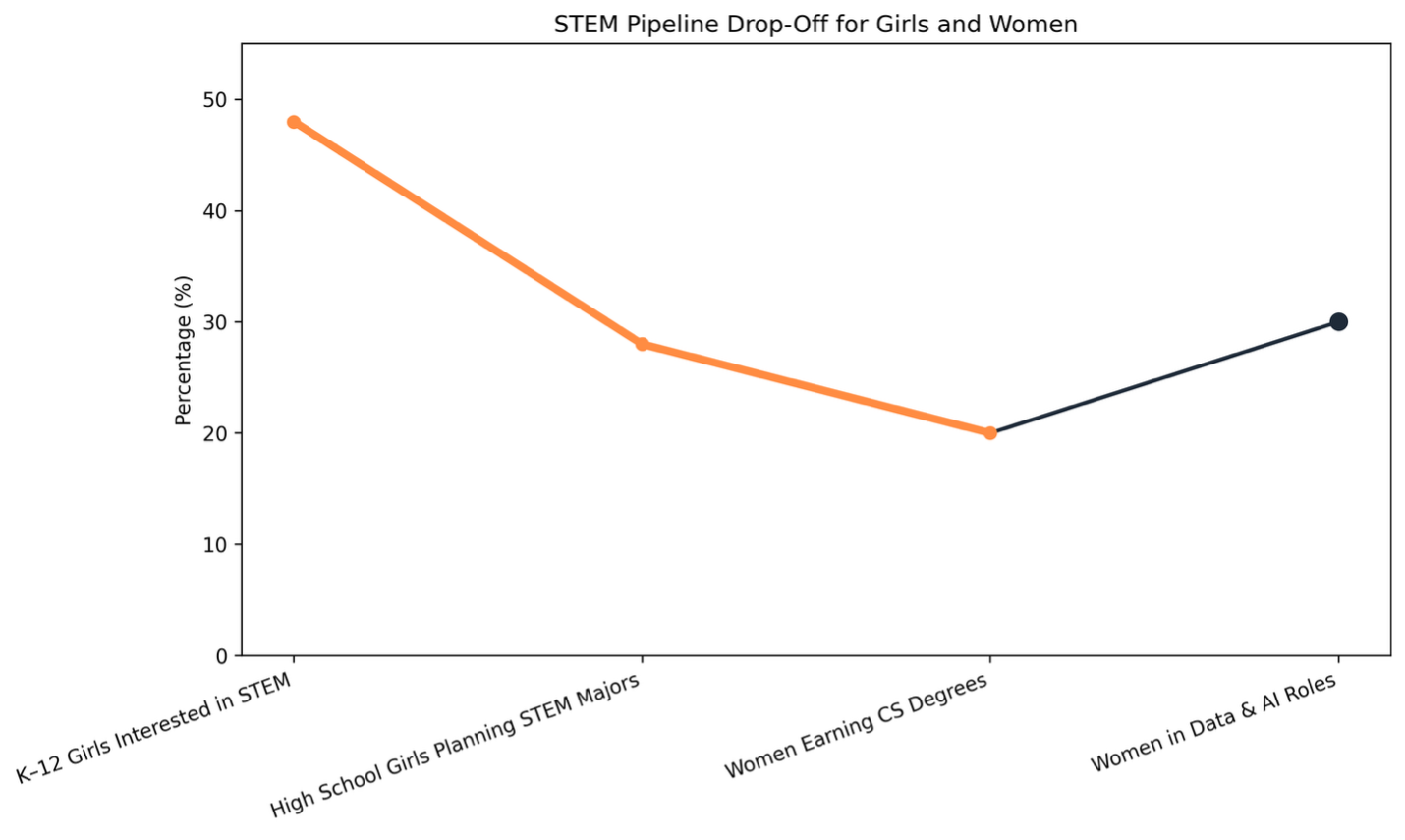
In early education, girls show strong enthusiasm for STEM. According to a synthesis of STEM participation research, roughly 48% percent of girls in K–12 report interest in STEM careers, and girls take math and science courses at rates comparable to boys through middle and high school.
However, interest begins to drop sharply during adolescence. By ages 15 to 16, girls are significantly less likely to envision themselves in computing or engineering careers, even when academic performance is equal to or higher than that of boys. By high school graduation, fewer than 28 percent of female students plan to major in STEM, compared to nearly 65 percent of male students.
The gap widens further after graduation. Although women earn over 50 percent of all bachelor’s degrees, they receive only 20 percent of computer science degrees and hold less than 30 percent of data science and AI roles in the U.S. workforce. Representation is even lower for Black, Latina, and Indigenous women.
So why does this gap persist?
Unconscious Bias
Deeply ingrained cultural stereotypes continue to frame STEM, especially computing and AI, as masculine fields. Research from Science Direct shows that girls and women are often perceived as less naturally talented in math and technical subjects, despite evidence to the contrary. These assumptions influence classroom interactions, hiring decisions, promotion opportunities, and self-perception.
To help individuals recognize and challenge these biases, Harvard University’s Project Implicit offers free Implicit Association Tests, including one focused on gender and science.
Media Representation and Visibility
Media portrayals play a powerful role in shaping career aspirations. A recent report from the Geena Davis Institute on Gender in Media found that nearly two-thirds of STEM characters in film and television are male, and women of color are dramatically underrepresented in technical roles. Black women account for fewer than 3 percent of portrayed STEM leads, reinforcing narrow stereotypes about who belongs in tech.
When girls rarely see people like themselves depicted as data scientists, AI engineers, or technical leaders, it directly impacts their confidence and sense of belonging.
The Confidence Gap in Math and Technical Skills
Confidence, not ability, is one of the strongest predictors of persistence in STEM. According to the National Council of Teachers of Mathematics, many girls begin to lose confidence in math as early as elementary school, even when achievement levels remain high. Boys, by contrast, are more likely to self-identify as good at math regardless of performance.
This confidence gap has long-term consequences. A multi-institution study found that women are 1.5 times more likely than men to leave STEM pathways after introductory college-level calculus, a foundational course for data science, machine learning, and AI careers.
Organizations such as the Association for Women in Mathematics provide free resources, mentorship, and professional support to help women build mathematical confidence at every stage.
How to Encourage Girls to Pursue Careers in Data Science, Machine Learning, and AI
The fields of data science, machine learning, and AI increasingly shape healthcare, climate research, business, education, and social justice. Yet many girls and women are never exposed to how broadly these tools can be applied or how impactful their contributions could be.
To encourage more girls to pursue careers in data science, machine learning, and AI, exposure needs to happen early and consistently. This includes integrating real-world, socially relevant examples of data and AI into K–12 education so girls can see how these skills connect to issues they care about, such as health, climate, social justice, and creative industries. Hands-on learning, project-based curricula, and access to role models who reflect diverse backgrounds all help counter stereotypes and make technical fields feel more welcoming and attainable. When girls are shown that data and AI are tools for problem-solving rather than abstract or isolated disciplines, their interest is more likely to persist through adolescence.
Equally important is sustained support through mentorship, confidence-building, and access to resources beyond the classroom. Programs that pair girls with mentors in data science and AI, provide opportunities for internships or research experiences, and normalize struggle as part of learning can significantly improve retention. Addressing the confidence gap in math and computing through supportive instruction, peer communities, and visible encouragement helps girls remain engaged even when coursework becomes more challenging. By combining early exposure with long-term structural support, educators, families, and institutions can help ensure that girls not only enter data science and AI pathways, but feel empowered to stay and thrive in them.
Free Resources for Women and Girls
Interactive AI & Data Activities
Machine Learning for Kids
A hands-on platform where children train real machine learning models to recognize text, images, numbers, and sounds using Scratch or beginner-friendly Python. Projects include chatbots, games, and simple AI applications.
Teachable Machine (Google AI)
A browser-based tool that lets children create image, sound, and pose recognition models using a webcam or microphone—no coding required. Ideal for understanding how AI learns from data.
Code.org
A free computer science education platform offering interactive lessons on algorithms, data, and introductory AI concepts through puzzles, videos, and guided activities for K–12 learners.
Minecraft Education
An educational version of Minecraft that teaches coding, logic, and computational thinking through immersive worlds and challenges, including lessons related to automation and data.
NASA Kids’ Club
STEM games and activities that help children practice math, science, and data skills while exploring space missions, planets, and Earth science.
Scratch
A visual programming language where kids build stories, animations, and games using drag-and-drop blocks that introduce logic, sequencing, and data concepts.
AI for Oceans
An interactive lesson where learners train an AI model to identify ocean objects, introducing image classification, data labeling, and ethical AI concepts.
CodeSpark Academy
A game-based coding platform for younger children that teaches problem-solving, loops, and conditionals through puzzles and storytelling before transitioning to real coding logic.
Khan Academy Kids
A free educational app focused on early math, logic, and reasoning skills that form the foundation for later success in statistics, data science, and AI.
Blockly Games
A collection of interactive coding games that teach algorithms, variables, and conditionals using visual blocks that gradually build computational thinking skills.
STEM Resources for Girls
Girls Who Code
Free clubs, summer immersion programs, and self-paced online courses that introduce girls and nonbinary students to coding, data concepts, and real-world tech projects.
Black Girls Code
Workshops, camps, and virtual programs that introduce Black girls to coding, robotics, data science, and AI through culturally responsive learning.
Technovation Girls
A global program where girls build mobile apps or AI-powered solutions to real-world problems while learning data analysis, machine learning basics, and entrepreneurship.
PBS SciGirls
Videos and hands-on activities that feature diverse girls solving STEM challenges together, emphasizing collaboration and applied scientific thinking.
EngineerGirl
Career exploration tools, interviews with women engineers, quizzes, and challenges designed to help girls understand engineering and technical careers.
Women at NASA
Profiles, videos, and educational resources highlighting women working in science, engineering, data, and space exploration at NASA.
Girl Scouts STEM Programs
STEM badges and leadership pathways focused on robotics, data, engineering, and problem-solving skills.
Delac Foundation
Free online coding workshops and introductory technical education for women in underrepresented communities worldwide.
STEM Like a Girl
Role-model stories, classroom resources, and career spotlights showing how girls use STEM and data skills in real jobs.
Math & Data Resources
Khan Academy
Free lessons in math, statistics, probability, and computing that build the quantitative foundations needed for data science and AI.
Brilliant
Interactive problem-solving courses in math, logic, and statistics that strengthen analytical thinking and intuition.
Desmos
A visualization tool for graphing equations and exploring data relationships interactively.
Prodigy Math
A game-based math platform that reinforces skills through adaptive challenges.
Zearn
Structured, standards-aligned math lessons focused on conceptual understanding and reasoning.
Math Is Fun
Plain-language explanations of math and statistics concepts with visuals and examples.
Open Middle
Open-ended math problems that encourage multiple solution paths and critical thinking.
DataCamp – Free Content
Introductory lessons in Python, SQL, statistics, and data literacy for beginners.
Statistics Online
Clear explanations of statistical concepts and formulas for early data learners.
Math Playground
Logic puzzles and games that build problem-solving and pattern-recognition skills.
Organizations and Scholarships for Young Professionals
Women in Machine Learning (WiML)
An international community that supports women in machine learning through technical workshops, research presentations, networking events, and mentorship opportunities focused on academic and industry careers.
Women in Data Science (WiDS)
A global initiative founded at Stanford University that hosts conferences, webinars, podcasts, and local chapters showcasing women leaders in data science across industries.
AI4ALL
A nonprofit organization offering free AI education programs, research exposure, and ethical AI training for students and early-career professionals from underrepresented groups.
DeepLearning.AI
Provides beginner-to-advanced courses in machine learning, deep learning, and generative AI, including free short courses and hands-on projects taught by industry experts.
Technovation
A global program offering events, scholarships, mentorship, and technical resources to support women pursuing careers in technology, data science, and AI.
Microsoft Learn
A free learning platform with structured learning paths in data science, AI, cloud computing, and analytics, including interactive labs and career-aligned skills training.
Society of Women Engineers (SWE)
Offers scholarships, career resources, leadership development, and professional networking for women pursuing engineering and technical careers.
AnitaB.org
A nonprofit focused on advancing women in technology through leadership programs, research, conferences (including the Grace Hopper Celebration), and workforce development initiatives.